
A Field Guide to the $42.5 Billion Blind Spot
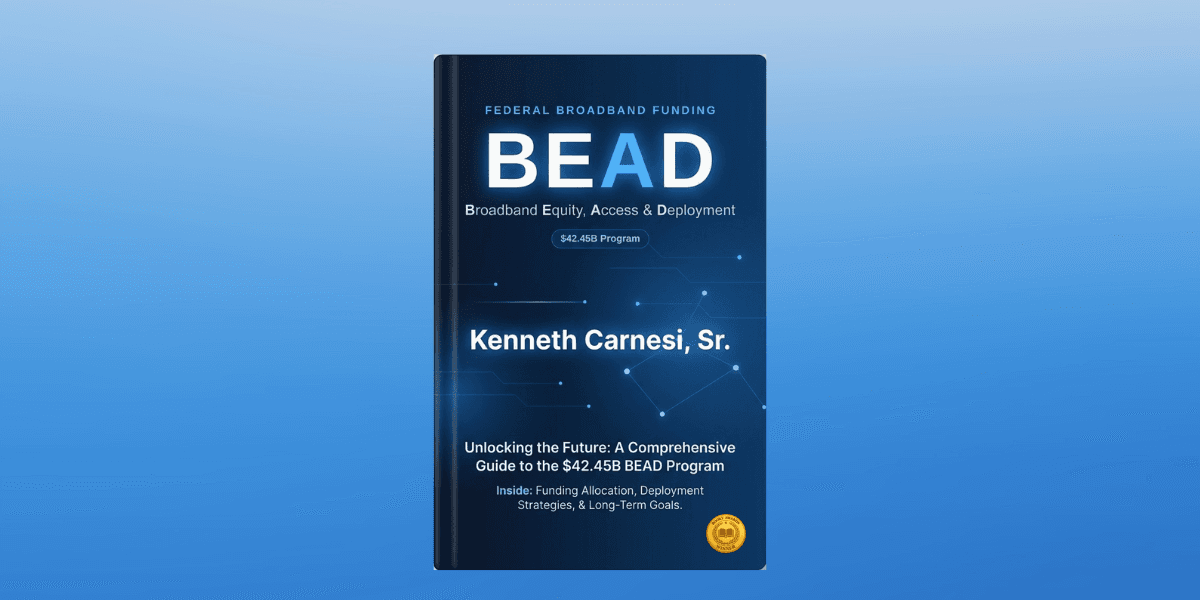
A Review of BEAD: Federal Broadband Equity, Access & Deployment Program: What It Means for Small Business IT Vendors, MSPs & ISPs by Kenneth Carnesi, Sr.
There is a peculiar kind of opportunity that hides in plain sight: one that is fully funded, publicly documented, and legally open to anyone who qualifies, yet remains invisible to the very businesses best positioned to benefit from it. Kenneth Carnesi's BEAD is built entirely around closing that gap. It takes one of the largest and most bureaucratically dense federal programs in American history, the $42.5 billion Broadband Equity, Access, and Deployment program created under the Infrastructure Investment and Jobs Act of 2021, and turns it into something a busy small IT vendor can actually use. That translation, more than any single chapter or checklist, is the book's real accomplishment.
Readers who have tried to research BEAD on their own will recognize the problem immediately. The program's governing documents, including NTIA's Notice of Funding Opportunity, run to well over a hundred pages of regulatory language written for state policy analysts, not for the owner of an eight person managed services company. Carnesi's central insight is that this gap between "the money is real" and "I have no idea how to get any of it" is exactly where most small vendors give up, and exactly where his book steps in. The tone throughout is direct, unpretentious, and clearly written by someone who has spent time on both sides of the table; someone fluent in federal program mechanics but who has also helped run, as a COO, a small technology business MSP. That dual fluency is rare, and it shows on nearly every page.
Structurally, the book follows a twelve-chapter progression that mirrors how vendors actually pursue BEAD opportunities. It explains what BEAD is, why funding remains available, and how money flows from Congress and NTIA through state broadband offices to the municipalities, counties, and other entities that hire vendors. Carnesi’s clear funding-chain metaphor reinforces his central point: federal agencies do not select vendors. The real opportunity lies at the local level, in city halls, library boards, housing authorities, and similar organizations.
This practical focus is where the book earns its subtitle. Carnesi treats BEAD as a business development opportunity rather than an abstract policy subject. He addresses regional opportunity mapping, municipal procurement, relationship building, and credibility before an RFP appears. His discussion of selling to municipalities is especially useful because it explains why government buyers often focus on risk, reliability, and accountability rather than price alone. For vendors accustomed to commercial sales, that distinction can be significant.
The treatment of the federal program itself deserves particular credit for its precision. Carnesi does not gloss over the compliance architecture that makes BEAD intimidating in the first place; he confronts it directly and makes it manageable. The book walks readers through the statutory definitions that determine project eligibility, including locations lacking 25/3 Mbps service that are "unserved," while those below 100/20 Mbps are "underserved," the minimum 100/20 Mbps performance standard that funded networks must meet, and the layered set of federal compliance obligations that attach to any BEAD funded contract: Buy American provisions under Section 70914, Davis Bacon prevailing wage requirements, Title VI and ADA accessibility obligations, and the Section 889 supply chain restrictions that prohibit the use of equipment from a specific list of manufacturers. Rather than leaving these as abstract legal citations, Carnesi consistently converts each one into a concrete action: check your equipment list against the FCC's published Section 889 list, look up Davis Bacon wage determinations for your county on SAM.gov, register before you need to, document your compliance posture before a municipality asks. It is this pattern, statute, plain language explanation, specific next step, repeated dozens of times across the book, that makes it function less like a summary of the law and more like an actual operating manual.
Two sections stand out as especially strong. The first covers teaming, subcontracting, and strategic partnerships, showing that small vendors can participate profitably without winning a prime contract. Carnesi explains how to find prime contractors seeking local partners and outlines protective teaming provisions, including use-or-pay clauses, liability caps, and payment terms that protect cash flow. This practical guidance makes the chapter especially valuable.
The second focuses on turning a BEAD installation into a long-term managed services relationship, a perspective particularly relevant to MSPs and ISPs. Carnesi argues that recurring managed Wi-Fi services can create more value than the initial installation. He supports the point with practical details on service levels, uptime, escalation, renewals, termination, insurance, and cybersecurity requirements. For businesses built on recurring revenue, this chapter reframes BEAD as an opportunity to expand the core business rather than pursue a one-time project.
Equally valuable, though easier to overlook amid the higher drama chapters on teaming and managed services, is the book's insistence that BEAD is not one national program but fifty different state programs wearing the same federal label. Carnesi devotes real attention to the fact that NTIA's framework sets outer boundaries while leaving states enormous discretion over how they structure subgrantee competitions, whether they run a scored proposal process or a formula based allocation, and how explicitly they build local vendor preference into their scoring criteria. The chapter on mapping regional opportunity translates this into a concrete exercise: pull location level broadband availability data from the FCC's National Broadband Map, cross reference it against a state's published list of eligible unserved and underserved locations, and build a prioritized target list of municipalities using a repeatable scoring framework. It is a small but important corrective to the assumption, common among vendors encountering BEAD for the first time, that a single national strategy will work everywhere. It will not, and the book is honest about that.
The chapter devoted to certifications, registrations, and compliance performs a similarly unglamorous but essential function. Federal contracting has a well earned reputation for tripping up capable companies over paperwork rather than performance, and Carnesi treats that risk with the seriousness it deserves. SAM.gov registration, state and municipal vendor portal registrations, equipment audits against federal supply chain restrictions, and manufacturer partner certification gaps are each walked through with enough specificity that a reader can complete them without hiring a consultant. The book's repeated insistence that these administrative steps be finished well before an RFP appears, rather than scrambled together against a deadline, is sound advice that many small businesses learn the hard way in any government contracting context, not just BEAD.
Stylistically, the book uses a direct second-person voice without unnecessary jargon. Carnesi clearly understands his audience: technically skilled, time-constrained owner-operators who want practical guidance rather than a government seminar. Each chapter ends with concrete action steps, keeping the focus on outcomes instead of general awareness.
The book closes with a ninety day action plan that is, in effect, the entire book compressed into a calendar. Broken into three thirty day phases covering foundational registrations and research, relationship building, and pipeline development, it gives readers dated, specific tasks rather than vague encouragement, complete SAM.gov registration on day one, build a Regional Opportunity Map by day ten, send outreach emails by day thirty one, and so on. It is a smart closing device: it takes everything the reader has just learned and forces the question of whether they will actually use it.
If there is a criticism to make, it is a minor one. The hypothetical vendor scenarios that appear throughout each chapter, while genuinely effective teaching tools, follow a fairly consistent formula, and a reader moving straight through the book cover to cover may notice the pattern repeating. This is a small price to pay for what those scenarios accomplish: they make abstract regulatory concepts concrete and memorable, which is precisely what a book aimed at busy practitioners, rather than policy scholars, needs to do.
What ultimately distinguishes this book is its argument that small businesses are not automatically disadvantaged. Carnesi shows how BEAD's structure can favor local vendors through community relationships, local knowledge, and responsiveness. For small IT vendors, MSPs, and local ISPs, this practical, statute-backed roadmap is the book's most valuable contribution.
For anyone in the small business IT, managed services, or local internet service provider community trying to figure out whether BEAD is worth their time, this book answers that question definitively and then does something more useful: it tells them exactly what to do next. It is a practical, well organized, and genuinely actionable guide to a federal program that most of its intended audience would otherwise never fully understand, and, for the vendors willing to act on it, a credible roadmap to real, recurring revenue.
Readers who want to explore Kenneth Carnesi, Sr.'s book and learn more about the BEAD opportunity can visit books.by to access the book and discover the practical guidance it provides for small business IT vendors, MSPs, and ISPs.

Juris Review Contributor
Covers legal news and the politics of the law, following legislation, enforcement, and the debate around both.
This article features partner, contributor, or branded content from a third party. Members of the Juris Review editorial staff were not involved in the creation of this content. All views and opinions are those of the contributor alone.