Kenneth Carnesi, Sr.'s Crossroads Series Examines the Foundations of American Constitutional Government
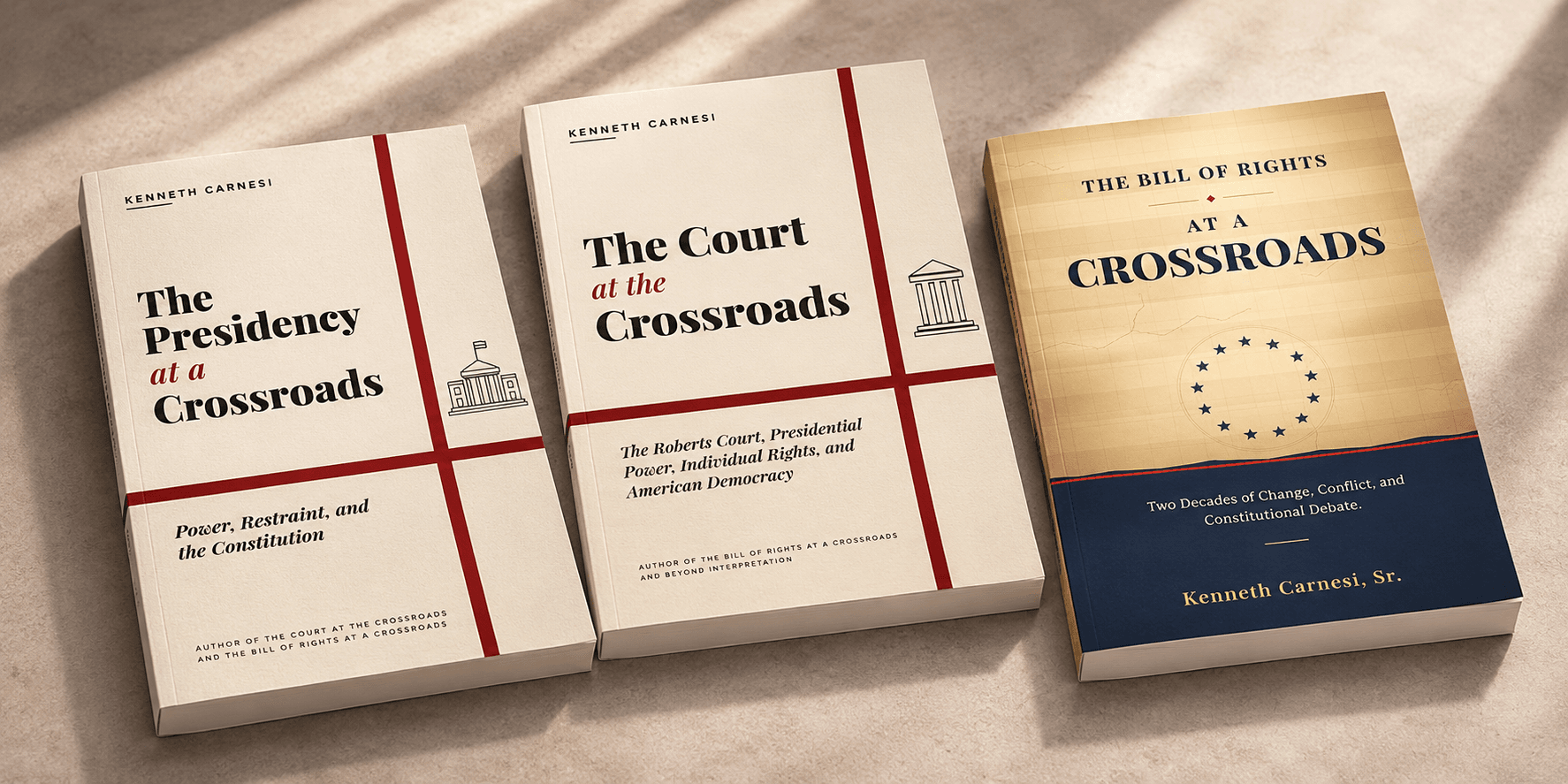
Kenneth Carnesi, Sr.'s three-book series explores individual rights, the Supreme Court, and presidential power in American constitutional government.
American constitutional debates often revolve around questions of power, individual freedom, and the institutions responsible for maintaining the balance between them. Yet understanding these issues requires more than following political headlines or reacting to individual court decisions. It requires examining the legal principles, historical developments, and institutional responsibilities that shape how the Constitution is interpreted and applied.
Author Kenneth Carnesi, Sr. explores these questions through his three-book legal commentary series: The Bill of Rights at a Crossroads, The Court at the Crossroads: The Roberts Court, Presidential Power, Individual Rights, and American Democracy, and The Presidency at a Crossroads: Power, Restraint, and the Constitution.
Together, the books offer a progression through three central dimensions of American constitutional government. The first examines the rights protected by the Constitution, the second considers how the judiciary interprets and applies those protections, and the third explores the authority of the presidency and the mechanisms intended to restrain executive power.
Rather than approaching these subjects as isolated political controversies, Carnesi organizes them around constitutional principles and the institutions responsible for upholding them.
Understanding the Rights That Shape American Life
The series begins with The Bill of Rights at a Crossroads, which examines how the first ten amendments have been interpreted and applied amid developments in law, technology, and public life.
The book considers how constitutional protections have been tested over the past two decades, emphasizing the distinction between the language of the amendments and how courts interpret those protections in practice.
Its 16 chapters are organized into three parts. The opening section establishes the constitutional framework, including the promises and limitations of individual rights, the institutions responsible for enforcing them, and the process through which constitutional protections were applied to the states.
The second section examines rights under pressure. Topics include freedom of speech and protest, religious exemptions, digital privacy, facial recognition, police encounters, detention, emergency powers, public defense, sentencing, firearm regulation, and the Ninth and Tenth Amendments.
The final section explores how constitutional rights change through judicial precedent, appointments, technological developments, national crises, and the actions of journalists, advocates, litigants, and voters.
A defining feature of the book is its effort to distinguish constitutional text, judicial doctrine, and practical application. Readers are encouraged to examine what an amendment says, how courts have interpreted it, and how those interpretations affect people in everyday situations.
The book also presents competing legal arguments rather than directing readers toward a predetermined political conclusion. As Carnesi explains, "I wrote this book so readers could see the reasoning on every side and decide for themselves."
This approach provides a foundation for understanding the constitutional questions that continue throughout the series.
Examining the Supreme Court's Role in Constitutional Interpretation
The second volume, The Court at the Crossroads: The Roberts Court, Presidential Power, Individual Rights, and American Democracy, shifts the focus from constitutional protections to the institution responsible for interpreting them.
Through 16 chapters, Carnesi examines two decades of Supreme Court decisions under Chief Justice John Roberts, exploring how judicial reasoning has influenced presidential authority, individual liberties, federal administrative power, elections, and the relationship between state and national government.
The book addresses major cases involving presidential immunity, administrative authority, freedom of expression, digital privacy, firearm regulations, abortion, and voting rights. Among the decisions discussed are Trump v. United States, Loper Bright Enterprises v. Raimondo, Dobbs v. Jackson Women's Health Organization, Shelby County v. Holder, and New York State Rifle & Pistol Association v. Bruen.
Carnesi also considers the historical foundations of judicial review, revisiting decisions such as Marbury v. Madison, Youngstown Sheet & Tube Co. v. Sawyer, and United States v. Nixon.
His method emphasizes the reasoning behind judicial decisions rather than simply their public reception. Readers encounter the legal dispute, the Court's ruling, the justices' arguments, the historical background, and the potential consequences for government institutions and individual citizens.
The book also gives attention to majority opinions and dissents, allowing readers to consider competing interpretations of constitutional principles.
One of its central themes is that understanding a Supreme Court decision requires more than knowing its outcome. Readers must also examine the legal reasoning supporting the decision and consider what it changes, what it preserves, and what questions remain unresolved.
This examination connects naturally to the first book: constitutional rights do not operate independently of the courts that interpret and enforce them.
Exploring Presidential Authority and Constitutional Restraints
The third volume, The Presidency at a Crossroads: Power, Restraint, and the Constitution, completes the series by examining executive authority and the mechanisms intended to hold presidential power accountable.
The book begins with a fundamental question: How much power can one president exercise, and what legal and political checks can meaningfully restrain that authority?
Carnesi distinguishes between legal checks, which courts or other branches can enforce, and political checks, which depend on officials and institutions choosing to act. This distinction provides the framework for examining presidential powers and the effectiveness of constitutional restraints.
Organized into four parts and 14 chapters, the book considers the constitutional design of the presidency, the instruments through which executive power is exercised, the institutions responsible for limiting that power, and potential reforms.
Its discussions cover executive orders, emergency declarations, federal agencies, foreign affairs, war powers, pardons, appointments, and presidential removal authority. Carnesi also examines the responsibilities of Congress, the judiciary, elections, impeachment, and the press in maintaining institutional accountability.
Historical events and judicial decisions provide context for these discussions. The book considers the Saturday Night Massacre, the War Powers Resolution, Youngstown Sheet & Tube Co. v. Sawyer, United States v. Nixon, and Trump v. United States.
A recurring concern is whether constitutional safeguards remain effective when the institutions responsible for enforcing them fail to act.
Rather than treating presidential authority as a purely legal question, Carnesi examines the relationship between constitutional text, historical practice, statutes, judicial decisions, and political norms. The result is an exploration of how executive power develops and why institutional participation matters when attempting to restrain it.
Recognized as South Carolina's Best Constitutional Law Book Series of 2026
Kenneth Carnesi, Sr.'s Crossroads series has also received recognition from News of America, which named it the Best Constitutional Law Book Series in South Carolina of 2026. The recognition highlights the series' contribution to discussions of American constitutional government through its examination of individual rights, judicial interpretation, and presidential authority. By bringing these three essential areas of constitutional law together, Carnesi's work offers readers an opportunity to explore the principles, institutional responsibilities, and legal debates that continue to shape American democracy. This recognition adds another milestone to the series' growing profile and its contribution to accessible legal and civic education.
Three Books, One Constitutional Conversation
Although each book addresses a different area of constitutional government, the three volumes are connected by a common interest in how American institutions exercise, interpret, and limit authority.
The Bill of Rights at a Crossroads establishes the discussion through individual liberties and constitutional protections. The Court at the Crossroads examines how judicial decisions define those protections and influence the distribution of governmental power. The Presidency at a Crossroads then considers executive authority and the legal and political mechanisms that can constrain it.
This progression gives the series a broader purpose beyond examining individual amendments, court decisions, or presidential actions. It encourages readers to consider how the different parts of the constitutional system interact and how changes in one institution can affect the responsibilities of another.
Carnesi's approach throughout the series emphasizes historical context, legal reasoning, competing interpretations, and accessible explanations. The books are written primarily for readers interested in law and government, including attorneys, law students, educators, journalists, policymakers, and engaged citizens.
Their structured discussions may also serve as useful reference material for classroom conversations, civic education, and readers seeking a deeper understanding of constitutional questions beyond daily political coverage.
A Continuing Examination of Constitutional Government
The Crossroads series presents constitutional government as an ongoing process shaped by interpretation, institutional responsibility, and changing circumstances. Its three books invite readers to consider not only what the Constitution establishes, but also how its principles function when tested by modern disputes and competing exercises of power.
By examining individual rights, the judiciary, and the presidency within one connected body of work, Kenneth Carnesi, Sr. offers a framework for understanding the relationships that sustain American constitutional government.
All three titles have been accepted by Barnes & Noble, and each has received prior coverage through JurisReview.com, including reviews of the individual books. Readers interested in exploring the series can learn more through Carnesi's official author website and book collection.
Explore the Crossroads Series
Readers can learn more about Kenneth Carnesi, Sr.'s books and other publications through his official author website, Books.by author collection, and LinkedIn profile.

Juris Review Contributor
Covers legal news and the politics of the law, following legislation, enforcement, and the debate around both.
This article features partner, contributor, or branded content from a third party. Members of the Juris Review editorial staff were not involved in the creation of this content. All views and opinions are those of the contributor alone.