A Review of The Presidency at a Crossroads: Power, Restraint, and the Constitution by Kenneth Carnesi, Sr.
Kenneth Carnesi, Sr. offers a clear, balanced examination of presidential power, constitutional limits, and the institutions that uphold accountability.
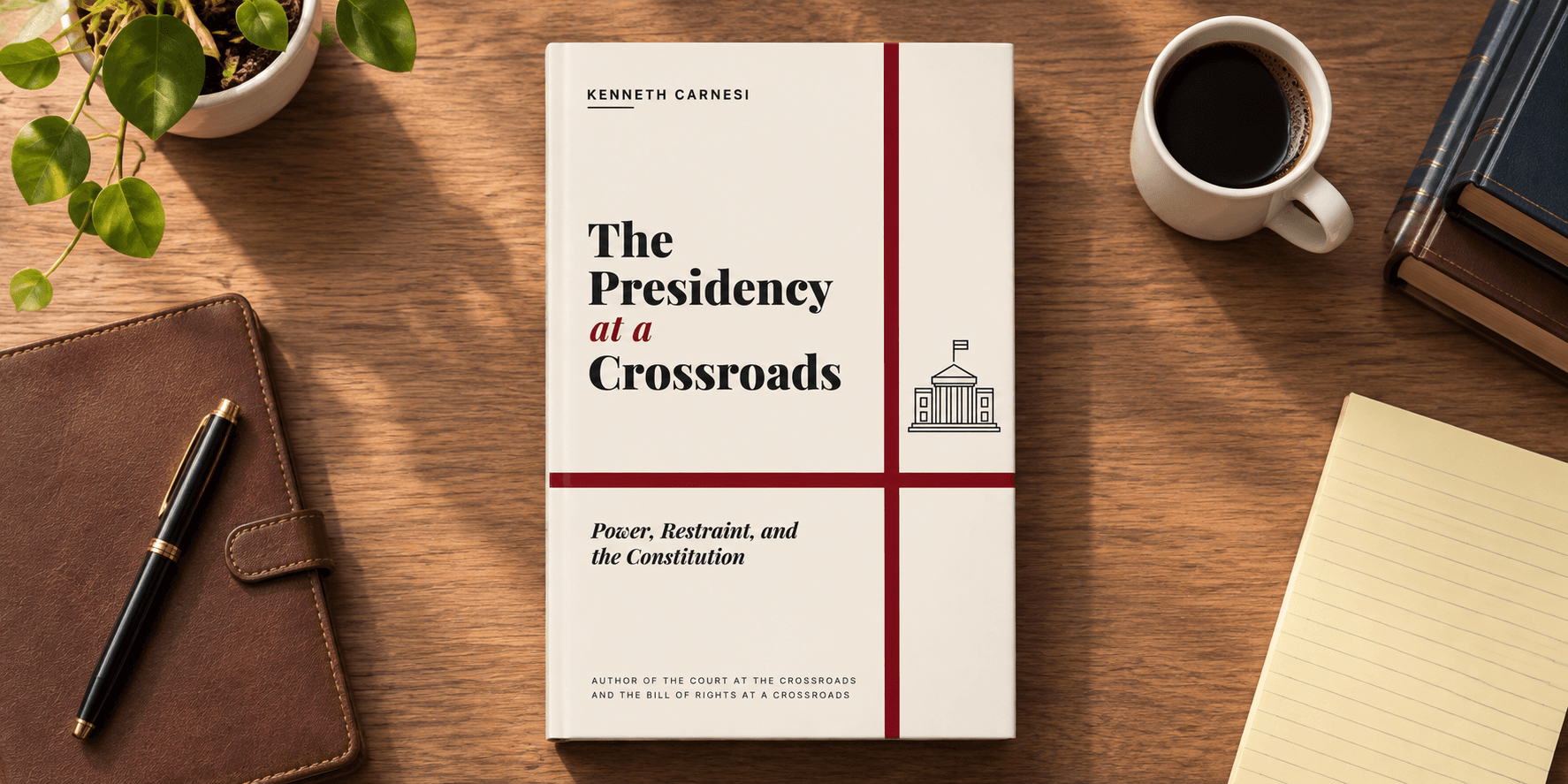
Kenneth Carnesi, Sr. brings clarity to the debate over presidential power in The Presidency at a Crossroads: Power, Restraint, and the Constitution. Through law, history, and balanced analysis, he helps readers understand executive authority beyond political loyalties.
The book opens with a central question: How much power can one President exercise, and what legal and political checks can meaningfully restrain that power? Carnesi begins by defining his terms. A legal check is a rule that a court or another branch can enforce against the President. A political check depends on officials and institutions choosing to act. The word “meaningfully,” he notes, “does separate work.” A limit that exists on paper but never alters an outcome restrains no one.
From that premise comes the book’s signature method. For every check on presidential power, Carnesi asks whether it exists, whether it has actually constrained a President, and what produced that result. Where a check has failed, he asks why. This three part test runs through all fourteen chapters, transforming a survey of constitutional doctrine into a practical framework for understanding presidential authority.
A Carefully Built Architecture
The book is organized into four parts. Part I, The Constitutional Design, begins with the Vesting Clause of Article II. Carnesi examines enumerated powers, competing interpretations of executive authority, and the 1793 exchange between Alexander Hamilton, writing as Pacificus, and James Madison, writing as Helvidius. He then explores the Constitutional Convention’s decision to vest executive power in one person and traces the presidency’s expansion through wartime authority, administrative growth, and mass media.
Part II, The Instruments of Presidential Power, forms the practical heart of the book. Chapters examine executive orders, emergency powers, federal agencies, foreign affairs, war, pardons, appointments, and removal authority. Carnesi explains where each power originates, how courts have tested it, and how Congress may restrict its exercise. His discussion of emergency powers is particularly effective. By examining the National Emergencies Act, the International Emergency Economic Powers Act, and the Stafford Act, he shows how emergency authority can endure long after the event that prompted it. One example concerns the national emergency declared following the 1979 seizure of the American embassy in Tehran, which has been renewed annually for decades.
Part III, The Limits and the Checks, examines Congress, the judiciary, elections, impeachment, and the press. Carnesi considers how partisan loyalty can weaken congressional oversight and how judicial decisions shape executive accountability. His discussion of Trump v. United States (2024) explains the Court’s distinction between absolute immunity for core constitutional powers, presumptive immunity for other official acts, and the absence of immunity for unofficial conduct. He presents competing arguments and uses practical examples to clarify their consequences.
Part IV, The Presidency at a Crossroads, turns toward constitutional norms and possible reforms. Carnesi explores how practices such as the cabinet, the in person State of the Union address, and the historical two term tradition influenced presidential conduct. He then evaluates proposals involving emergency declarations, congressional subpoenas, and presidential records. His central concern is whether reforms would change outcomes when institutions fail to act.
Balance as a Discipline, Not a Pose
The book’s greatest strength may be its fairness. Many works on presidential power seek to prove a position. Carnesi seeks to illuminate the constitutional questions behind competing positions.
He promises to present the strongest version of each argument before evaluating it, without treating contested questions as settled or giving unequal arguments equal weight. His treatment of unitary executive theory draws on Steven Calabresi and Christopher Yoo, while also examining Elena Kagan’s work on presidential administration and arguments supporting independent agencies.
Carnesi also distinguishes five sources of constitutional authority: constitutional text, historical practice, statutes, judicial decisions, and political norms. By identifying their different legal force, he helps readers separate binding requirements from established expectations. This distinction is essential to understanding why some presidential restraints survive legal challenges while others depend entirely on institutional cooperation.
The Cases, Told Clearly
Carnesi makes landmark judicial decisions accessible without sacrificing their complexity. The Prize Cases (1863), Myers v. United States, Humphrey’s Executor, Youngstown Sheet & Tube Co. v. Sawyer, United States v. Nixon, INS v. Chadha, Morrison v. Olson, Seila Law, and Trump v. United States appear within the broader development of presidential authority.
He encourages readers to begin with a decision’s holding before examining its reasoning. A holding often resolves a narrow legal question, while its practical consequences depend on how later courts interpret its scope. This approach gives lawyers precision and provides readers without legal training a manageable path through complex doctrine.
History receives similar attention. The Saturday Night Massacre of October 1973, when Attorney General Elliot Richardson resigned rather than dismiss special prosecutor Archibald Cox, becomes a lesson in institutional resistance. Congress’s override of the veto of the War Powers Resolution, the steel seizure litigation, and disputes over presidential removal authority likewise illustrate how constitutional checks function under pressure.
These episodes serve a larger purpose. Rather than presenting history as a collection of famous confrontations, Carnesi examines what made resistance effective, what weakened it, and what those outcomes reveal about constitutional government.
A Conclusion Worth the Journey
The concluding chapter, Power That Can Be Checked, brings the book’s arguments together. Carnesi maintains that an energetic presidency can coexist with meaningful constitutional restraints, but only when institutions and officials exercise the powers available to them.
His most revealing observation concerns situations in which the default favors executive authority. An emergency may continue through presidential notice. The War Powers Resolution depends partly on the interpretation of “hostilities,” a term the statute leaves undefined. Presidential immunity depends on how courts classify official conduct.
For Carnesi, the strongest reforms are those that change what happens when no institution intervenes.
The book closes with a practical guide to evaluating future presidencies. Readers are encouraged to examine the legal authority claimed by executive orders, the statutes supporting emergency declarations, congressional responses, judicial remedies, and the significance of officials who refuse questionable instructions.
Its final question captures the book’s central concern: What happens when no one acts?
The Third Volume In An Essential Series
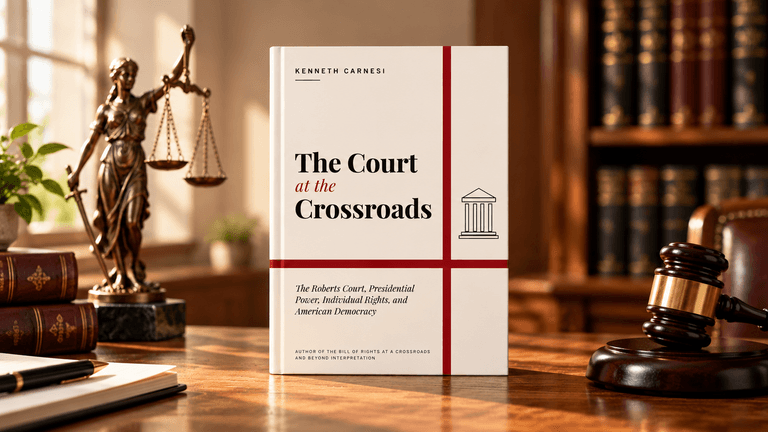
The Presidency at a Crossroads is the third volume in Carnesi’s legal commentary series. It follows The Bill of Rights at a Crossroads, which examines constitutional liberties, and The Court at the Crossroads: The Roberts Court, Presidential Power, Individual Rights, and American Democracy, which considers the Supreme Court’s role in defining governmental authority.
Together, the three books follow a natural progression from individual rights to judicial interpretation and finally to presidential power. Readers familiar with Carnesi’s earlier work will recognize his careful sourcing, accessible explanations, and preference for analysis over rhetoric.
The new volume also stands independently. Its structure and explanations allow readers unfamiliar with the series to follow the constitutional debates without extensive legal knowledge.
Who Should Read This Book
Carnesi writes primarily for lawyers and law students, but his audience extends well beyond the legal profession. Journalists, congressional staff, policy professionals, educators, political science students, and engaged citizens will find value in his clear explanations.
His practical advice is especially useful for readers without formal legal training. He recommends keeping the Constitution nearby, reading complete clauses rather than isolated phrases, and asking three questions throughout: What power is at issue, where does its authority originate, and what restrains it?
These habits make the book suitable for classrooms, civic education programs, and reading groups seeking informed discussions about constitutional government.
At a time when debates about executive authority often generate more conviction than understanding, The Presidency at a Crossroads offers a rigorous and readable examination of how presidential power operates, where constitutional limits have held, and where they have strained.
Its lasting contribution is not simply explaining what Presidents can do. It is showing readers how to recognize the difference between power that is legally granted, power that is politically tolerated, and power that can genuinely be checked.
Explore Kenneth Carnesi, Sr.’s Constitutional Commentary
For readers interested in the constitutional foundations of presidential authority, The Presidency at a Crossroads provides an accessible starting point. Its combination of historical context, judicial analysis, and practical questions offers a framework for examining the presidency beyond individual administrations.
The Presidency at a Crossroads: Power, Restraint, and the Constitution by Kenneth Carnesi, Sr. is published by Books.by (2026; ISBN 9798908588829). It follows The Bill of Rights at a Crossroads and The Court at the Crossroads.
Learn more about the book and explore the author’s legal commentary series at kennethcarnesiauthor.me.

Juris Review Contributor
Covers legal news and the politics of the law, following legislation, enforcement, and the debate around both.
This article features partner, contributor, or branded content from a third party. Members of the Juris Review editorial staff were not involved in the creation of this content. All views and opinions are those of the contributor alone.