

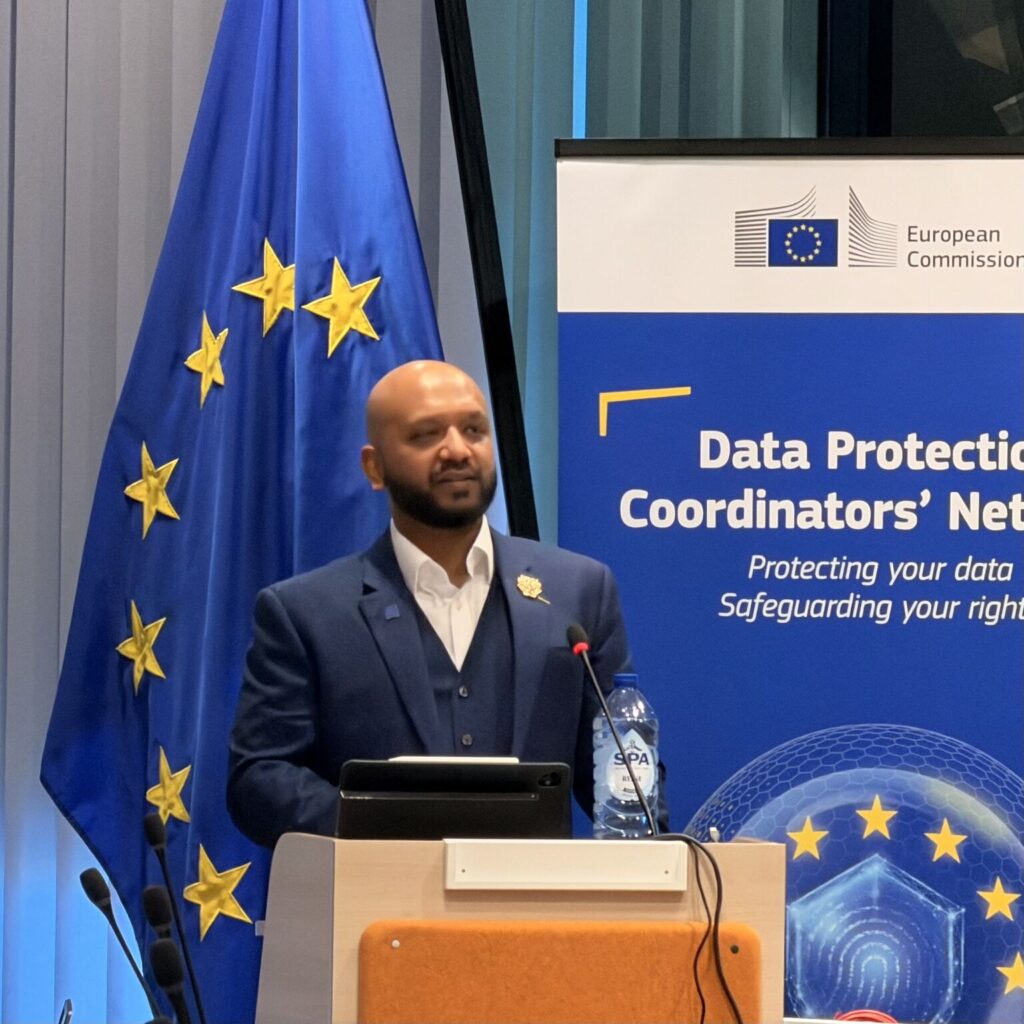
At the European Commission, Jamal Ahmed shared a challenge: compliance expertise alone won’t protect organizations in an AI-driven world of data protection.
The room was filled with people responsible for protecting some of Europe’s most sensitive data. Privacy officers from across the European Commission’s directorates. Legal advisers navigating GDPR enforcement. Professionals managing data governance for institutions that set policy for 450 million people.
And the message they heard challenged everything about how they’d been trained to think about their work.
“Privacy professionals are often seen as the people who enforce rules,” Jamal Ahmed told the audience gathered at Commission headquarters. “But the future of privacy depends on something much bigger: leadership, influence, and the ability to guide organizations toward responsible data practices.”
It wasn’t a compliance training session. It was a wake-up call.
The Problem Hiding in Plain Sight
Here’s what most business leaders don’t realize about their privacy teams: The people responsible for protecting their most valuable asset (customer trust) have been systematically trained to stay invisible.
Privacy professionals learn regulations. They master documentation. They become experts at saying “no” to risky business initiatives. What they don’t learn? How to sit at the executive table and help leadership navigate the messy intersection of innovation, risk, and responsibility.
The consequences are playing out across boardrooms worldwide.
As artificial intelligence transforms how businesses operate, as data becomes the competitive differentiator in every industry, as regulations multiply across jurisdictions, organizations desperately need strategic guidance on data governance. Instead, they have compliance officers managing documentation while executives make critical technology decisions without understanding the privacy implications.
Martina Levi, an EU qualified lawyer working on data protection and AI at the European Commission, described how Ahmed’s presentation shifted her perspective. “It made me reflect on my daily work with a fresh perspective, reminding me why I originally chose the field of privacy (to protect a fundamental human right),” she noted.
The gap between what privacy professionals can do and what they’re empowered to do is costing organizations more than regulatory fines. It’s costing them trust.
Why This Matters Beyond Privacy Departments
If you’re a CEO, CTO, or board member, this directly impacts you.
Your privacy team likely knows about business risks related to AI systems, data practices, and international expansion, but their insights might not be making it into strategic discussions. Often, privacy is seen as a compliance role, not a strategic advisor.
As Ahmed highlighted in his message to the European Commission, privacy can’t remain a back-office function. It’s now central to business strategy, competitive advantage, and organizational resilience. The issue isn’t a lack of expertise, but rather a narrow view of the role privacy professionals play in shaping business decisions.
The Actionable Insight Professionals Are Missing
Youssef Elshabasi, a data protection professional at the European Commission, attended the keynote as he considered his next career move. “What stood out most was his reminder that privacy is not only about knowing the rules, it is about communicating them clearly and confidently, and translating experience into real value for an organisation,” Elshabasi reflected. “His practical guidance on how to explain complex requirements was insightful, engaging, and immediately useful.”
That transformation from technical expertise to strategic communication represents exactly what organizations need but rarely get from privacy teams.
Ahmed’s keynote outlined what strategic privacy leadership actually looks like:
Translating Risk into Business Language
Privacy professionals who can explain data governance challenges in terms executives understand (revenue impact, competitive positioning, stakeholder trust) become invaluable strategic partners rather than regulatory gatekeepers.
Shaping Organizational Culture
The most effective privacy programs don’t rely on policies and audits alone. They’re built into how organizations make decisions, design products, and engage with customers. That requires influence, not just authority.
Navigating Technology Governance
As AI, analytics, and digital transformation accelerate, organizations need advisors who understand both technological capability and ethical responsibility. Privacy professionals are uniquely positioned to bridge that gap if they’re empowered to do so.
Building Trust as Competitive Advantage
In markets where data breaches make headlines and consumer skepticism grows, demonstrable privacy leadership isn’t compliance theater. It’s a differentiator that drives customer confidence and long-term value.
These aren’t theoretical capabilities. They’re what separates organizations that treat privacy as regulatory overhead from those that leverage it as strategic strength.
The Inflection Point
The timing of Ahmed’s message reflects a moment of significant change across industries.
Privacy regulations continue proliferating globally. The EU AI Act introduces governance requirements that extend far beyond traditional data protection. Organizations face enforcement actions measured not just in fines but in reputational damage that affects market valuation.
Simultaneously, technology is advancing faster than regulatory frameworks can adapt. Generative AI. Biometric systems. Automated decision-making. Global data ecosystems of unprecedented complexity.
Business leaders navigating this environment need more than compliance checklists. They need strategic advisors who can help them balance innovation with responsibility, competitive advantage with ethical data stewardship, growth with sustainable trust.
Most privacy professionals have the expertise to provide that guidance. Few have been trained (or organizationally positioned) to deliver it effectively.
Ahmed’s keynote, at the request of the European Commission’s Data Protection Officer, challenged privacy professionals to claim that strategic role. Marie Devambé, who works in data protection at the Commission, noted she “particularly appreciated his C5 Framework and the importance of adopting a growth mindset.”
The emphasis on mindset alongside technical knowledge signals a broader shift in how privacy expertise must evolve.
What Business Leaders Must Understand
If your organization still treats privacy as a compliance function that reviews initiatives after business decisions are made, you’re operating with a dangerous blind spot.
The privacy professionals on your team likely understand risks to your business that aren’t surfacing in executive discussions. They see emerging regulatory challenges before they become enforcement actions. They know where your competitive practices might erode the trust you’re trying to build.
But if you’ve positioned them as administrators rather than advisors, if they report through compliance rather than strategy, if they’re invited to meetings only when legal review is required, you’re not getting the value their expertise could provide.
Strategic privacy leadership doesn’t mean slowing down innovation. It means making better-informed decisions about how to innovate responsibly.
It doesn’t mean saying “no” to every technology initiative. It means helping leadership understand which risks are worth taking and how to mitigate them effectively.
It doesn’t mean treating data governance as overhead. It means recognizing it as infrastructure that enables sustainable growth.
The Ability to Inspire Action
Georgia Bakatsia, a Legal Officer at the European Data Protection Supervisor, attended one of Ahmed’s presentations on building careers in data protection. “Jamal has a clear talent for breaking down complex topics and presenting them in a way that is practical, engaging, and easy to understand,” Bakatsia observed. “What stood out most was how actionable his advice was.”
That focus on actionability rather than theoretical knowledge reflects what privacy professionals need to become effective strategic leaders. The ability to inspire confidence, communicate clearly, and drive organizational change matters as much as regulatory expertise.
Elshabasi noted he “left the session genuinely inspired, with a clearer perspective on how to grow in this field.”
For a profession historically focused on technical compliance, this shift toward leadership development, strategic communication, and organizational influence represents a fundamental evolution in how privacy expertise creates value.
The Legacy Question
Ahmed closed his keynote with a challenge that extends beyond the privacy profession:
“The world doesn’t just need people who understand privacy law. It needs leaders who can guide organizations through complex decisions about technology, ethics, and human rights.”
For privacy professionals, that means moving beyond reactive compliance (responding to incidents, regulations, and audits) toward proactive leadership that shapes how organizations govern data and protect fundamental rights.
For business leaders, it means recognizing that the people responsible for data governance need to be strategic partners, not administrative gatekeepers.
For the profession as a whole, it means redefining what privacy expertise looks like in an age when data touches every aspect of organizational strategy.
In a digital economy where trust has become one of the most valuable assets an organization can hold, privacy leadership isn’t a nice-to-have capability. It’s essential infrastructure.
The question isn’t whether privacy professionals have the expertise to provide strategic guidance. Most do.
The question is whether organizations will empower them to use it, and whether the profession itself will step forward to claim that leadership role.
“Step forward,” Ahmed concluded.
“Lead with purpose.
Leave a legacy.”
For organizations navigating an increasingly complex regulatory and technological landscape, the privacy professionals already on their teams may be the strategic resource they’ve been overlooking.
The challenge is recognizing them as such before your competitors do.
Jamal Ahmed is a global privacy educator, bestselling author of Easy Peasy Guide to GDPR, founder of Privacy Pros Academy, training professionals in 137 countries, and providing expert media commentary.
Learn more about Privacy Pros Academy
Listen to the Privacy Pros Podcast
Connect with Jamal Ahmed on LinkedIn